Mechanical Cable Assembly – Engineering Evaluation & Functional Testing Specification
Component: Mechanical cable-actuated circular assembly
Material: Steel housing with steel cable and mixed metallic subcomponents
Application Context: Mechanical actuation / tensioning system (automotive or industrial)
Study Type: Engineering inspection and non-destructive functional assessment
OEM Context: Stellantis-style legacy component evaluation and teardown documentation
Testing Objective
Evaluate the structural integrity, surface condition, and functional readiness of a mechanical cable assembly recovered from service or storage. Testing is intended to identify wear mechanisms, degradation patterns, and potential performance risks prior to reuse, refurbishment, or comparative analysis.
nspection & Test Methodology
1. Visual & Macro Inspection (Non-Destructive)
High-resolution macro imaging used to document:
Cable routing and winding consistency
Crimp terminations and attachment points
Housing geometry and concentric alignment
Surface oxidation, residue, and wear patterns
Inspection performed in as-received condition with no cleaning or mechanical manipulation prior to documentation.
2. Manual Actuation Assessment
Cable manually tensioned through full available travel range (where accessible).
Observations recorded for:
Smoothness of motion
Binding, hesitation, or uneven resistance
Audible mechanical noise indicative of internal interference
3. Rotational / Hub Evaluation
Central hub or rotating element assessed for:
Free rotation consistency
Axial or radial play
Evidence of bearing surface degradation
4. Surface Condition Assessment
Oxidation levels visually categorized (light / moderate / advanced).
Localized wear at cable contact points and guide surfaces documented.
Residue presence evaluated for potential contamination-related friction increase.
Observed Conditions (Representative)
Cable remains continuously wound with no visible strand separation or catastrophic fraying.
Crimped cable ends appear mechanically intact with localized coating loss.
Housing exhibits uniform concentric geometry with no visible deformation.
Surface oxidation present on exposed metallic surfaces, consistent with age-related environmental exposure.
Residue accumulation observed within recessed areas, potentially contributing to increased friction.
Engineering Interpretation
Observed conditions indicate progressive wear and environmental degradation consistent with extended service life rather than acute mechanical failure. Cable integrity appears maintained; however, surface oxidation and residue accumulation may adversely affect actuation smoothness, load consistency, and long-term reliability.
While no immediate structural failure indicators are present, functional performance under load cannot be fully validated without controlled force, cycle, and endurance testing.
Recommended Follow-Up Testing (If Required)
Cable tension load testing to verify elastic behavior and load retention
Cycle testing to evaluate wear progression under repeated actuation
Disassembly-based inspection for internal wear surface evaluation
Lubrication response testing to assess friction reduction potential
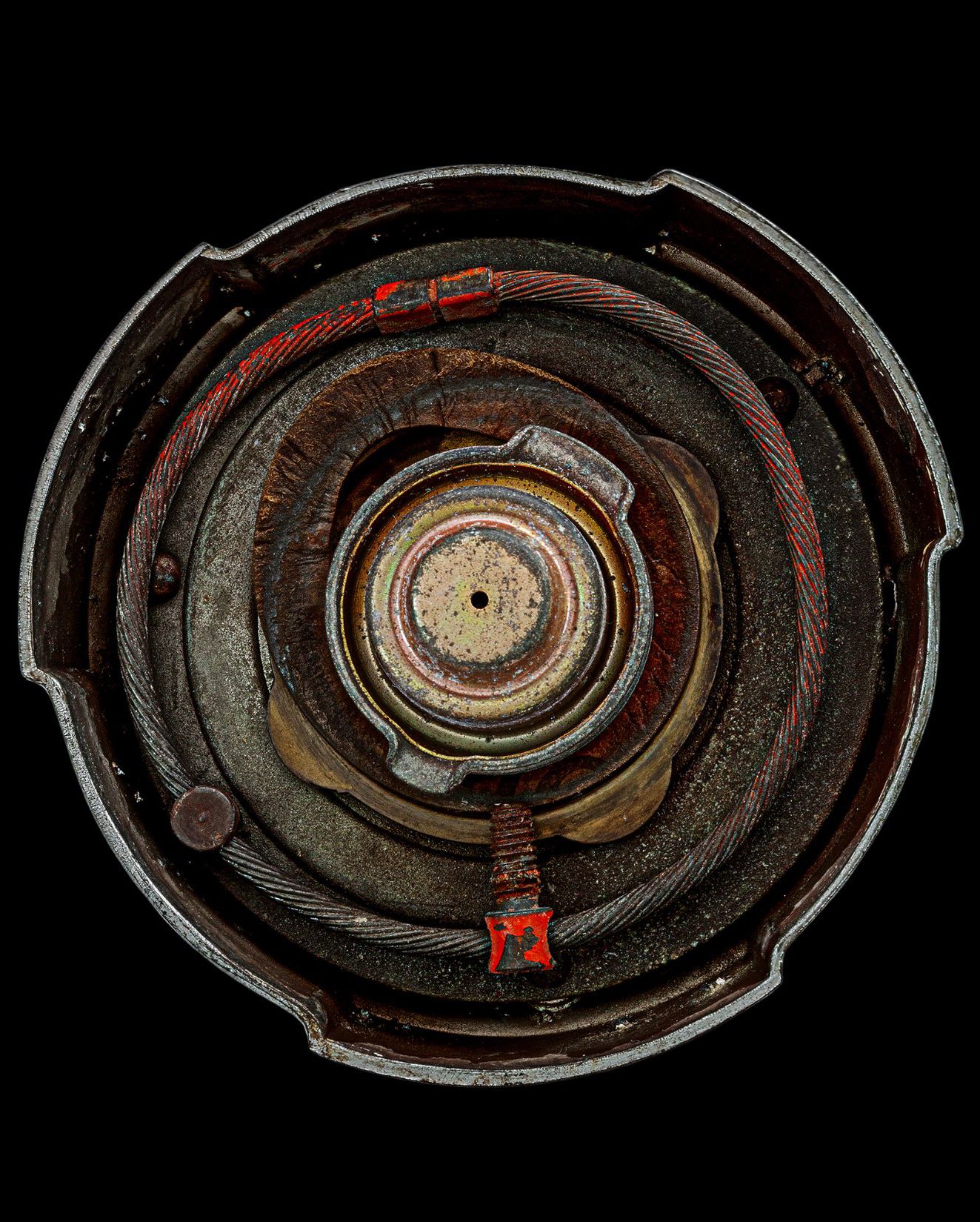
Image Specifications –
Mechanical Cable Assembly Macro Study
Camera: Canon EOS 5D Mark IV
Lens: Canon 24-70mm
Exposure Settings:
ISO: 100
Aperture: f/13 (to maximize depth on metallic structures)
Shutter Speed: 1/160 sec
Focus Stacking: 15 images
Lighting: Macro Photography Flash Diffuser with Speedlite Flash Diffuser Softbox to manage harsh reflections and sculpt highlights
Stability: Tripod-mounted; timer; macro rail
Processing: Focus stack blended in Adobe Photoshop; contrast and clarity enhanced for technical accuracy